
AI Search Optimization Strategy: How to Get Your Brand Mentioned by ChatGPT, Gemini & Perplexity
Ask ChatGPT for “the best freelance SEO expert in Kochi “. You will see how few local businesses get named. Most do not appear at all. If you want that to change, you need an AI search optimization strategy, not a handful of keywords.
What Is an AI Search Optimization Strategy?
AI search optimization means making your brand easy for tools like ChatGPT, Gemini, and Perplexity to understand, trust, and mention. You are no longer only competing for ten links. You are competing to be named inside a written answer.
A solid AI search optimization strategy still starts with SEO basics… The focus shifts a little. Here is how the two compare:
AI Search Optimization Strategy vs Traditional SEO
| SEO | AI Search Optimization |
|---|---|
| Goal | Rank a page in results |
| Main signal | Keywords, links, page quality |
| Result format | List of links |
| How you measure it | Rankings and traffic |
| Goal | Get your brand named in an answer |
| Main signal | Clear brand info, authority, consistent mentions |
| Result format | Written answer sometimes with citations |
| How you measure it | Mentions, accuracy, and citations across many prompts |
How I Test My AI Search Optimization Strategy
Before changing anything, I wanted a baseline. So I wrote questions a customer might ask:
- “Who are some freelance digital marketing experts in Kochi?”
- “Best freelance SEO expert in Kochi”
- “Who can help a small business with SEO and Meta Ads in Kochi?”
For every prompt, I record three things:
- Is my website mentioned?
- Is my brand described correctly?
- Does the tool link to Cite the site?
I never judge by an answer. AI responses change with wording, location, date, and model. So I test variations and check again over time.
How to Get Your Business Recommended by ChatGPT: 3 Starting Steps
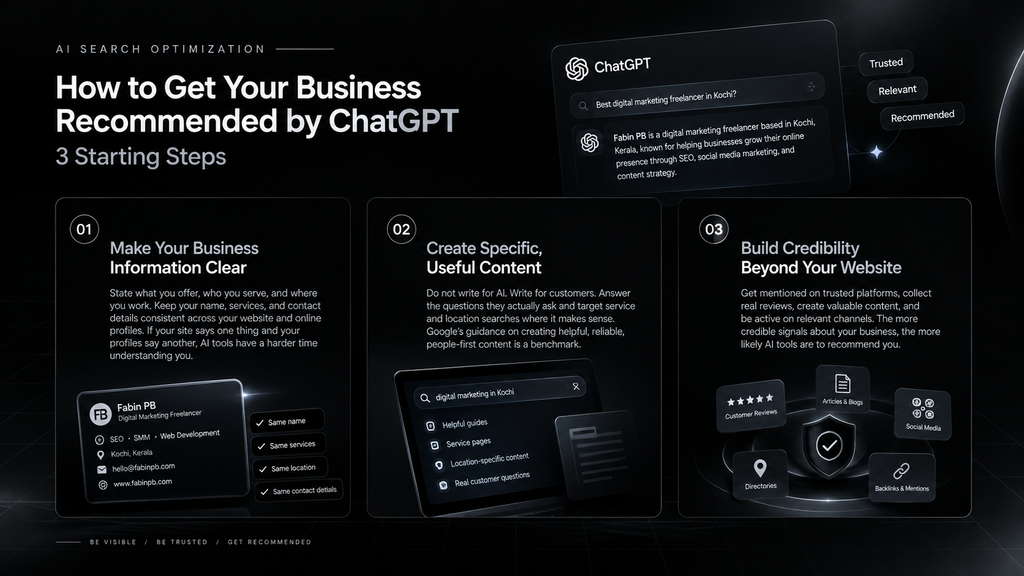
1.Make Your Business Information Clear
State what you offer, who you serve, and where you work. Keep your name, services, and contact details consistent across your website and online profiles. If your site says one thing and your profiles say another, AI tools have a time understanding you.
2.Create Specific, Useful Content
Do not write for AI. Write for customers. Answer the questions they actually ask and target service and location searches where it makes sense. Google’s guidance on creating helpful, reliable, people‑first content is a benchmark.
3.Build Credibility Beyond Your Website
Your website tells people who you’re. Other sources back it up. Collect reviews, keep business profiles accurate, and earn mentions on relevant, trustworthy sites.
What I’ve Changed on fabinpb.com So
Here is what I have done on my own site:
- Narrowed the focus to digital marketing services in Kochi: SEO, social media marketing, and Meta Ads
- Rewrote my service descriptions
- Improved the About, projects, certifications, and tools sections
- Updated contact information and site structure
- Targeted phrases like “freelance digital marketing expert in Kochi” without stuffing them everywhere
I believe the most important change is clarity. A visitor or an AI tool should quickly learn who I am, what I do, where I work, and who I help. To be clear, that is my working theory. I have not proven it yet.
Common Mistakes in AI Search Optimization
Believing Keywords Will Do It
The biggest myth is that adding a few keywords will get ChatGPT to recommend you. It will not. AI tools need reliable information to understand your business and judge whether it is credible. That comes from your website, content, reviews, and third‑party mentions.
Trusting One AI Response
One answer proves little. If your brand appears once, do not celebrate. If it does not appear once, do not panic. Test multiple. Look for patterns.
Expecting Results Too Quickly
In my experience, progress is gradual. Strong content, clear brand information, and authoritative mentions add up slowly.
Ignoring Off‑Site Signals
A perfect website helps,. It is only one source. Weak reviews, outdated profiles, and zero mentions elsewhere can hold you back.
Track Your Results With a Simple Log
Tracking is the part of any AI search optimization strategy that people skip. A basic spreadsheet is enough:
| Date | Tool | Prompt | Mentioned? | Described correctly? | Citation? |
|---|---|---|---|---|---|
| Oct 5 | ChatGPT | Best freelance SEO expert in Kochi | Yes/No | Yes/No | Yes/No |
| Oct 5 | Gemini | Freelance digital marketing expert in Kochi | Yes/No | Yes/No | Yes/No |
| Oct 5 | Perplexity | SEO expert for small businesses in Kochi | Yes/No | Yes/No | Yes/No |
Check periodically, not daily. Compare results over weeks and months. Note what you changed in between. Over time, you can see whether your improvements line up with visibility.
Limitations of AI Search Optimization
No AI search optimization strategy guarantees a mention. AI tools work differently. Their answers shift. Local markets also vary, so what works for a Kochi freelancer may not work for a brand… When visibility improves, it is hard to prove which change caused it. Treat results as patterns, not proof.
FAQs About AI Search Optimization
Can I pay to be recommended by ChatGPT?
As far as I know, there is no direct way to buy a recommendation inside AI-generated answers. The practical route is to earn visibility through useful information, content, and credibility.
How long does AI search optimization take?
There is no fixed timeline. In my testing, change is gradual. I track results over time instead of expecting quick wins.
Does AI search optimization replace SEO?
No. Good SEO gives you the foundation. AI search optimization builds on it with brand information and stronger off-site signals.
Conclusion: Building a Practical AI Search Optimization Strategy
A practical AI search optimization strategy comes down to three things: be clear about who you are, publish content that genuinely helps customers, and build credibility beyond your own site. Then test, record, and be patient.
Your next steps:
Write five customer questions and test them in ChatGPT, Gemini, and Perplexity.
Check that your business details match everywhere online.
Publish one helpful page that answers a real customer question.
Ask a happy client for an honest review.
Re-test in a few weeks and compare.
Do not write for AI. Write for customers. Answer the questions they actually ask and target service and location searches where it makes sense. Google’s guidance on creating helpful, reliable, people-first content is a benchmark.